Learning objective 11.4.3.1 identify the advantages and disadvantages of using artificial intelligence in society.
Artificial intelligence in society: advantages and disadvantages
Artificial intelligence can support decisions, automate tasks, and generate content. Its effects reach beyond individual users: they can change how people learn, work, communicate, and access services.
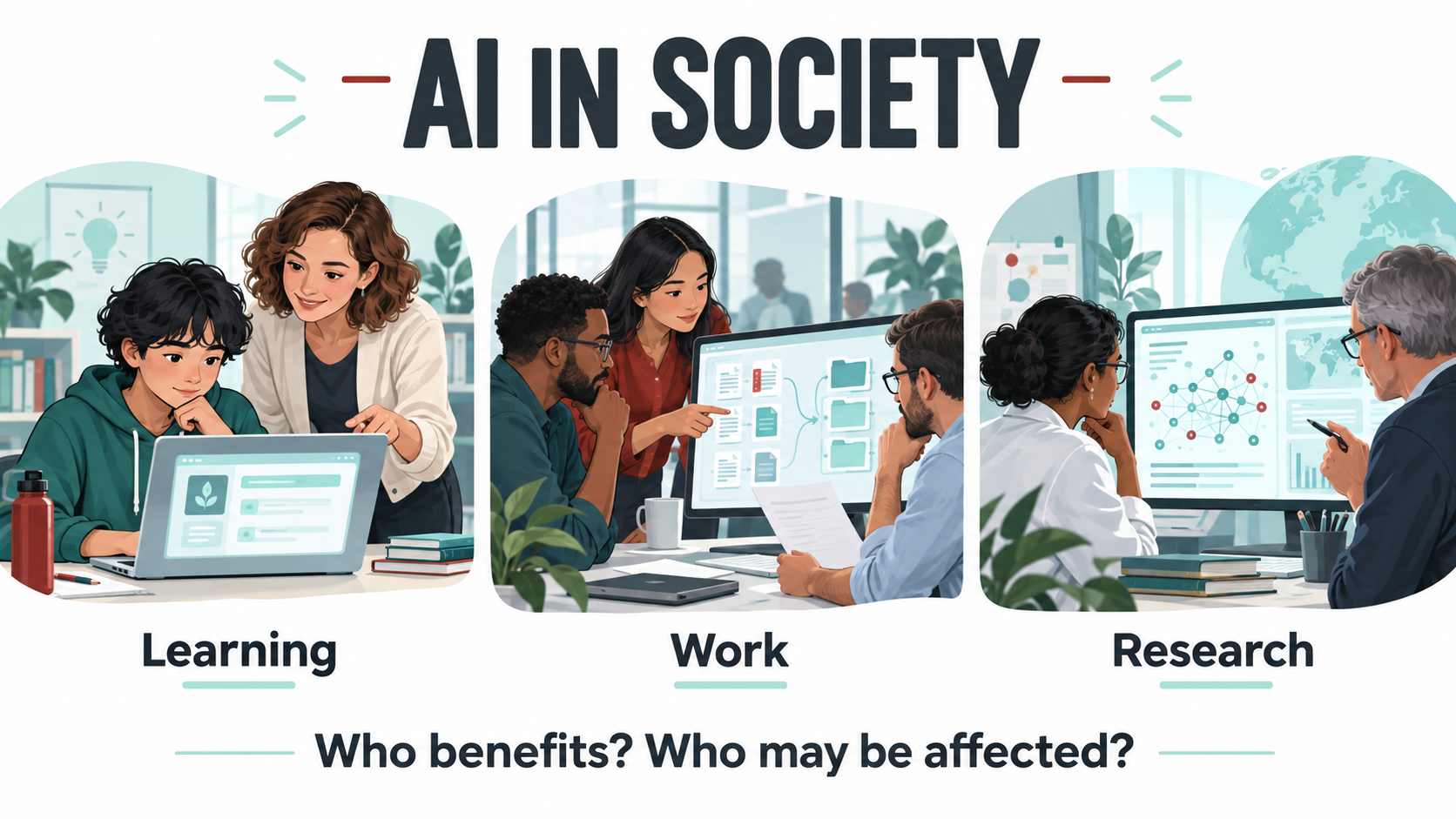
AI application → benefit or risk → effect on people
Ask: who benefits, who may be harmed, and under what conditions?
AI is not automatically beneficial or harmful. Outcomes depend on the task, the data, the system’s reliability and how people use it. An advantage is a potential benefit; a disadvantage is a limitation, cost, or risk. A risk does not mean that harm will always occur.
1. Advantages of using AI
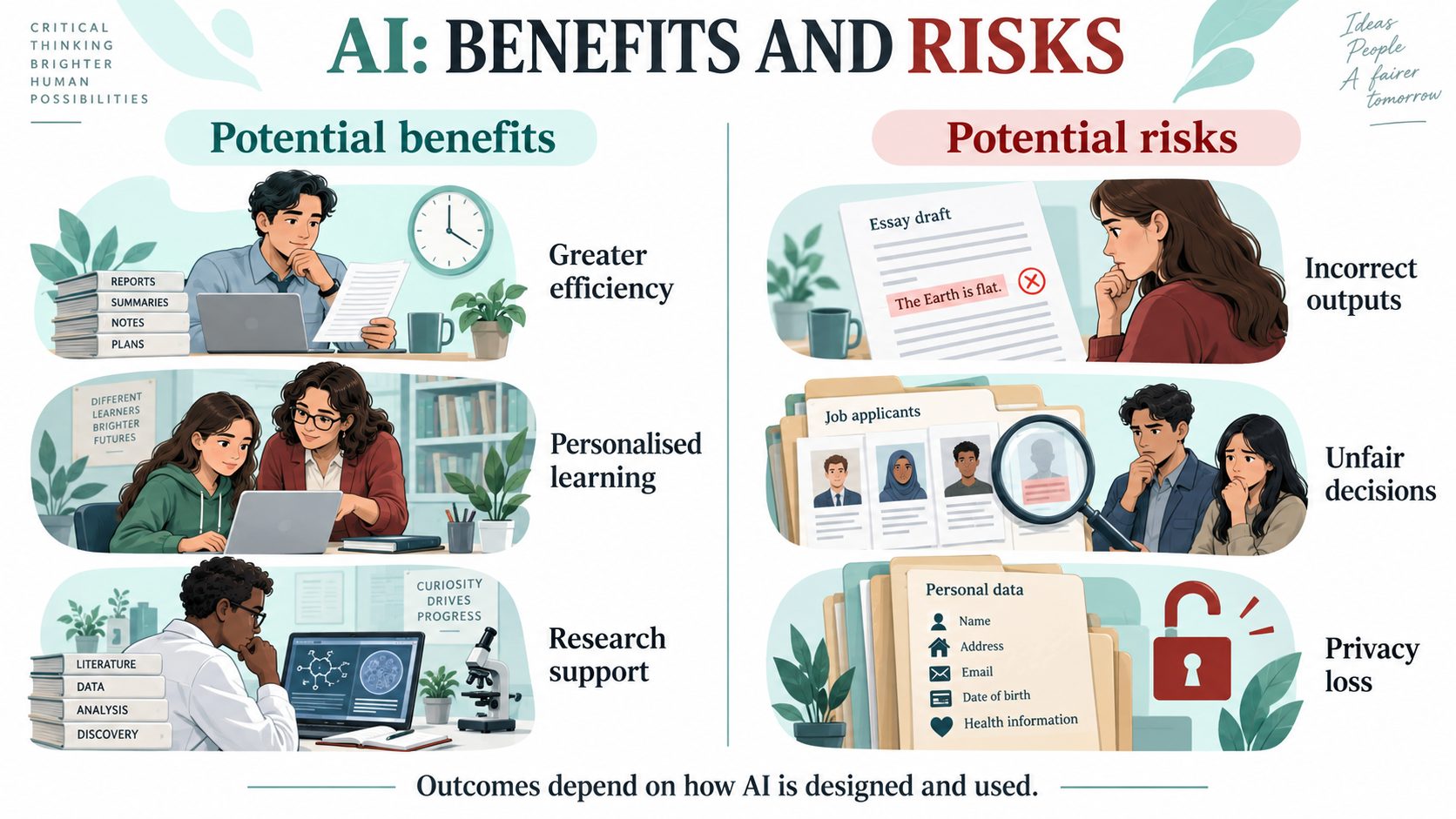
- Greater efficiency. AI can process large amounts of information and automate some routine tasks, leaving people more time for other work.
- Decision support. Finding patterns in data can help people make predictions and investigate problems. A prediction still needs appropriate evaluation.
- Scientific progress. AI can help researchers explore data and potential solutions more quickly. These are opportunities, not guarantees of useful discoveries.
These potential benefits are discussed by the OECD AI Principles and the OECD report on future AI benefits and risks.
- Personalised learning. Educational AI can adapt support to learners’ needs, helping them practise areas they find difficult.
- Improved access. Appropriately designed AI tools can help more people access learning and services. However, access to devices, connectivity and suitable tools still matters.
Read about educational opportunities and inclusion in UNESCO’s guidance on learners’ rights.
2. Disadvantages and risks of using AI
- Incorrect or unreliable outputs. AI can make mistakes. If people accept its output without checking, those errors can influence decisions.
- Bias and unfair treatment. A system may perform differently for different groups. Biased data or design choices can contribute to unfair outcomes.
- Privacy risks. Collecting and using personal information can expose people to unwanted monitoring or inappropriate use of their data.
- Limited explainability. Some AI decisions are difficult to understand, making mistakes harder to investigate or challenge.
Reliability, fairness, privacy and explainability are central to NIST’s description of trustworthy AI.
- Changes to employment. Automation can replace some tasks and change the skills workers need. Some people may need retraining; the effect is not identical for every job.
- Misinformation and misuse. AI can be used to produce misleading content or support fraud, harming trust and decision-making.
- Unequal benefits. Organisations with greater resources may gain more from AI, while others have limited access or influence.
These wider challenges are addressed in UNESCO’s Recommendation on the Ethics of AI and the OECD report on social risks.
Remember: “AI is faster” is incomplete. State what it does faster and why this matters to people. Similarly, “AI is dangerous” needs a specific risk and consequence.
One application can have both benefits and risks
The following are illustrative classroom scenarios, not reports about named products or organisations.
The table applies the reliability and fairness concerns described by NIST, the educational considerations discussed by UNESCO, and the wider benefits and risks outlined by OECD.
3. How to explain an impact
- Identify the advantage or disadvantage.
- Explain how the AI application produces that effect.
- Name the affected people and the consequence for them.
Answer frame: “One advantage/disadvantage is ___. This happens because ___. As a result, ___.”
Example: “One disadvantage of AI-based recruitment is unfair treatment. If the system ranks a group unfairly, qualified applicants from that group may lose interview opportunities.”
Extension: suggest a relevant safeguard, such as checking outputs, testing performance across groups, protecting personal data or allowing a human review. Safeguards can reduce risks; they do not guarantee that every problem disappears. These approaches reflect the emphasis on human oversight in UNESCO’s AI ethics recommendation.
Activity 1 — Identify the impact
For each scenario, identify one advantage or disadvantage and explain its effect on people. 10 marks: 1 for a valid impact and 1 for a linked explanation in each case.
- A learning tool gives extra practice in the topics a student finds difficult.
- An AI recruitment tool repeatedly ranks qualified applicants from one group lower than others.
- An organisation uses AI to sort requests, allowing staff to respond sooner.
- An AI assistant shares private user information with an unintended recipient.
- A public notice includes a false statement from an AI-generated draft that nobody checked.
Show answers and marking guidance
- Personalisation: practice targets difficulties, helping the student improve.
- Bias/unfair treatment: qualified people may lose opportunities because of the ranking.
- Efficiency: faster sorting reduces waiting time for people seeking help.
- Loss of privacy: personal information becomes available to someone who should not receive it.
- Unreliable information: readers may make decisions based on a false claim.
Accept equivalent answers. Do not award the explanation mark for simply repeating the impact’s name.
Activity 2 — Compare perspectives
Scenario: an organisation introduces AI to handle routine written requests. Managers expect shorter waiting times. Employees will need to learn how to review AI outputs.
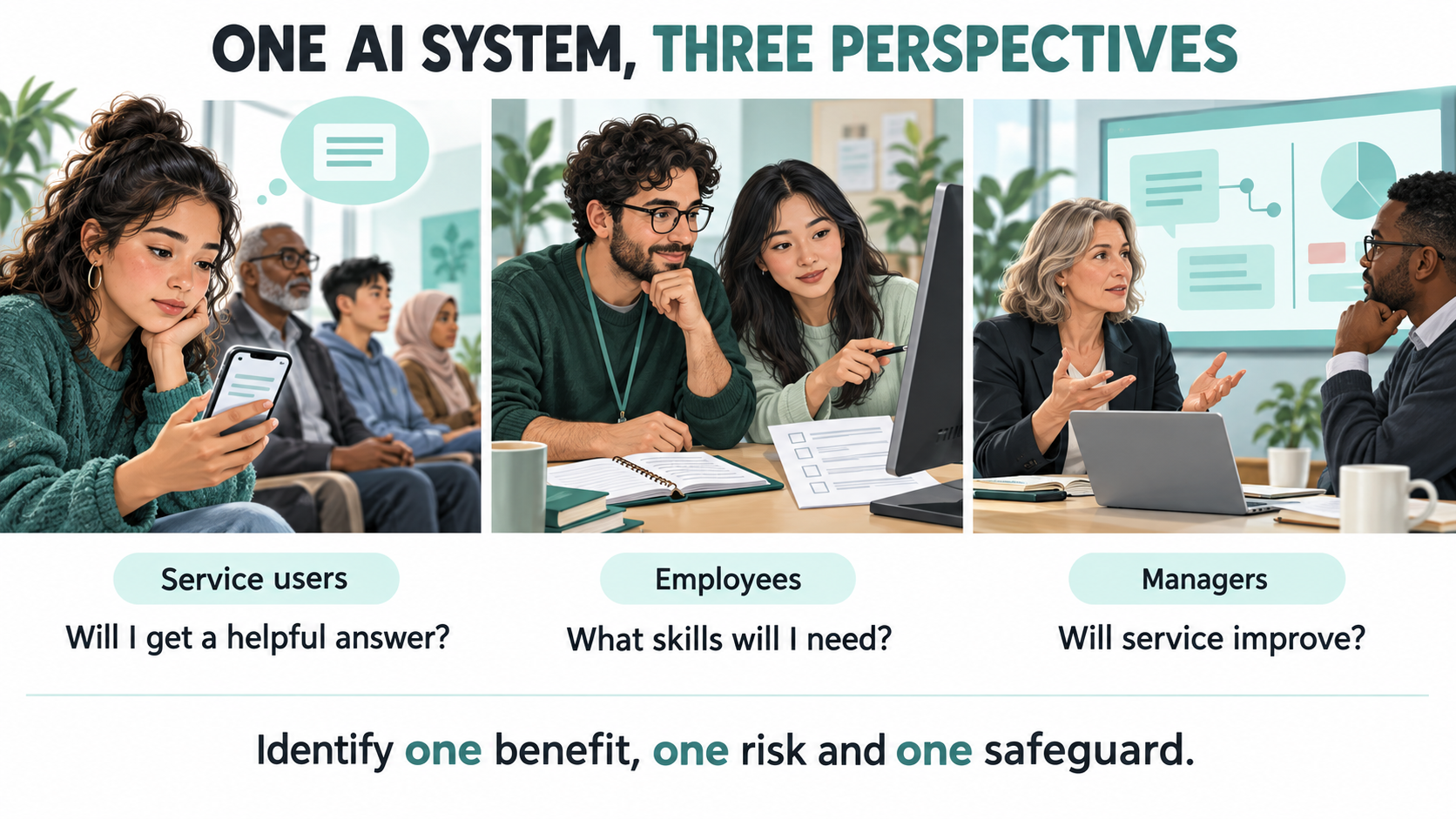
In groups, consider the perspectives of service users, employees and managers. Prepare a short response that:
- identifies one advantage and explains who benefits;
- identifies one disadvantage and explains who may be affected;
- suggests one safeguard linked to that disadvantage.
Assessment: 6 marks. Award 1 for each valid advantage, disadvantage and safeguard, plus 1 for each linked explanation. The safeguard is an extension beyond the core identification objective.
Show an example response
Advantage: quicker handling of routine requests may reduce waiting time for service users.
Disadvantage: incorrect AI responses may give users misleading information.
Safeguard: trained staff review uncertain responses and handle escalated requests, reducing the chance that an error reaches a user.
Other valid responses may discuss retraining, privacy, or changes to employees’ tasks. The scenario does not support the claim that all staff will lose their jobs.
Activity 3 — Correct the misconceptions
Correct each statement. 4 marks: 1 for each accurate correction.
- AI always makes fair decisions because computers have no feelings.
- If AI automates one task, the whole job must disappear.
- An AI-generated statement is reliable if it sounds confident.
- The same AI system benefits everyone equally.
Show suggested corrections
- Data and design choices can lead to unfair outcomes.
- Automating a task may change a job; it does not necessarily remove the entire role.
- Confident wording is not evidence of accuracy; claims need checking.
- Benefits depend on access, needs and how the system performs for different people.
Self-check
- Can I identify three advantages of AI for society?
- Can I identify three disadvantages or risks?
- Can I explain who is affected and how?
- Can I show how one application creates both a benefit and a risk?
- Can I avoid absolute claims such as “AI is always accurate”?
Key takeaway: identify the impact, explain the consequence, and consider the people affected.
Related lesson: Artificial intelligence, machine learning and deep learning.
Exercises
Ex 1. Assign each description to the correct group.
Ex 2. Match each AI-related problem with its most directly related consequence.
Ex 3. Complete the text using the correct terms.