Learning objective 11.4.3.3 identify the differences between artificial intelligence, machine learning, and deep learning
Artificial intelligence, machine learning, and deep learning
Artificial intelligence, machine learning, and deep learning are related concepts. They are not three separate alternatives.
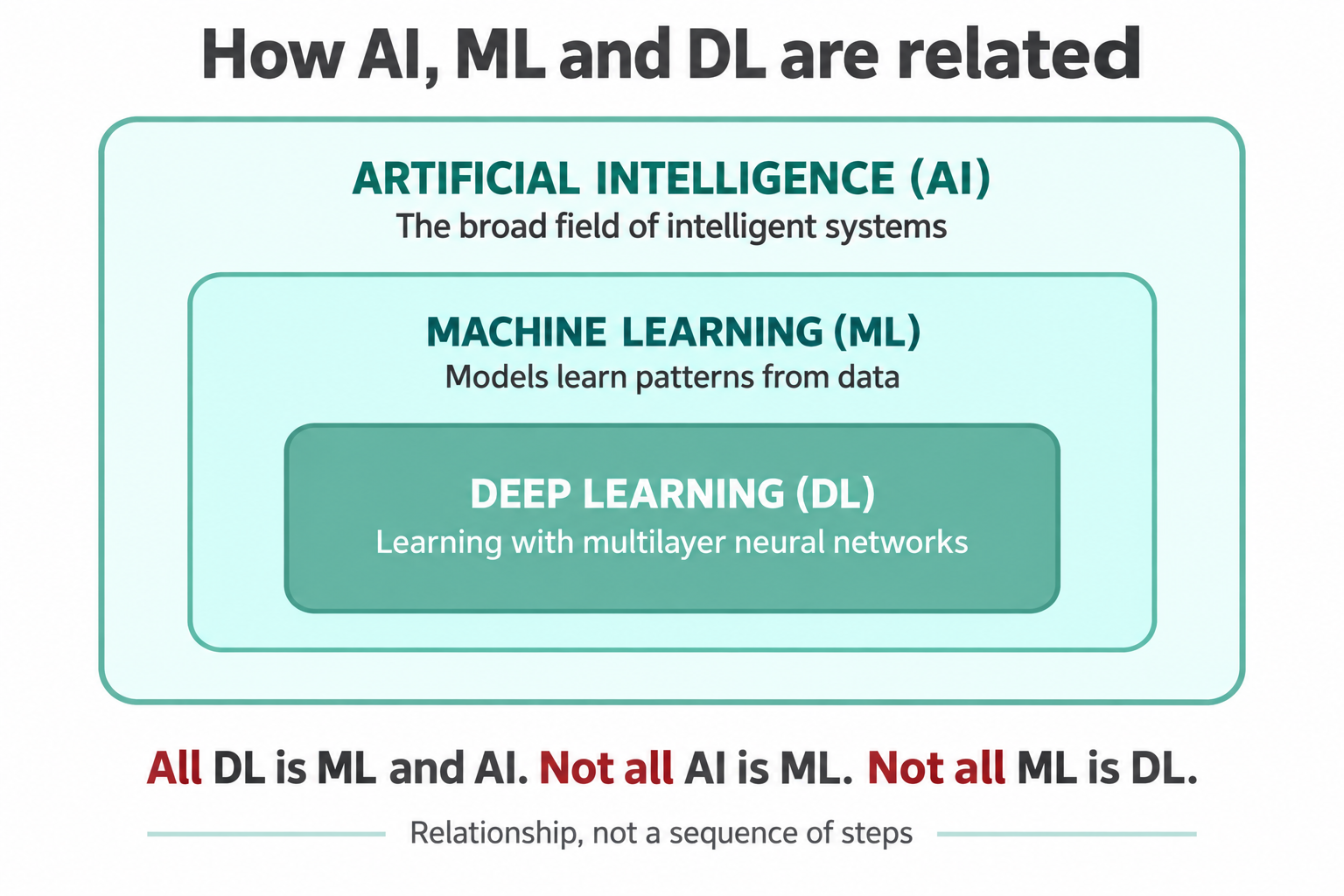
Deep learning ⊂ Machine learning ⊂ Artificial intelligence
The symbol ⊂ means “is a subset of”.
- Every deep-learning system is also a machine-learning system and an AI system.
- Not every machine-learning system uses deep learning.
- Not every AI system learns from data.
Classify a system by its method, not just by its purpose. For example, the word “chatbot” alone does not tell you whether the system uses predefined rules or a trained model. Read about the relationship between AI, ML, and DL (IBM).
1. Artificial intelligence (AI)
Artificial intelligence (or AI) is the ability of a computer to perform tasks such as reasoning and learning that human intelligence is capable of doing.
AI includes several approaches. A system may use human-written knowledge and reasoning rules, or it may learn from data.
Illustrative example: a troubleshooting expert system uses a knowledge base and inference rules supplied by specialists to suggest the cause of a computer fault. If it does not learn from examples, this is rule-based AI rather than ML.
A program does not become AI simply because it contains an if statement. In the example, the key feature is using encoded expert knowledge to reason about a problem. More about AI (IBM).
2. Machine learning (ML)
Machine learning is a subset of AI in which a model learns patterns from data rather than relying only on manually written rules for every decision.
During training, an algorithm adjusts a model using data. During inference, the trained model produces an output for a new input. A model does not necessarily continue learning every time someone uses it.
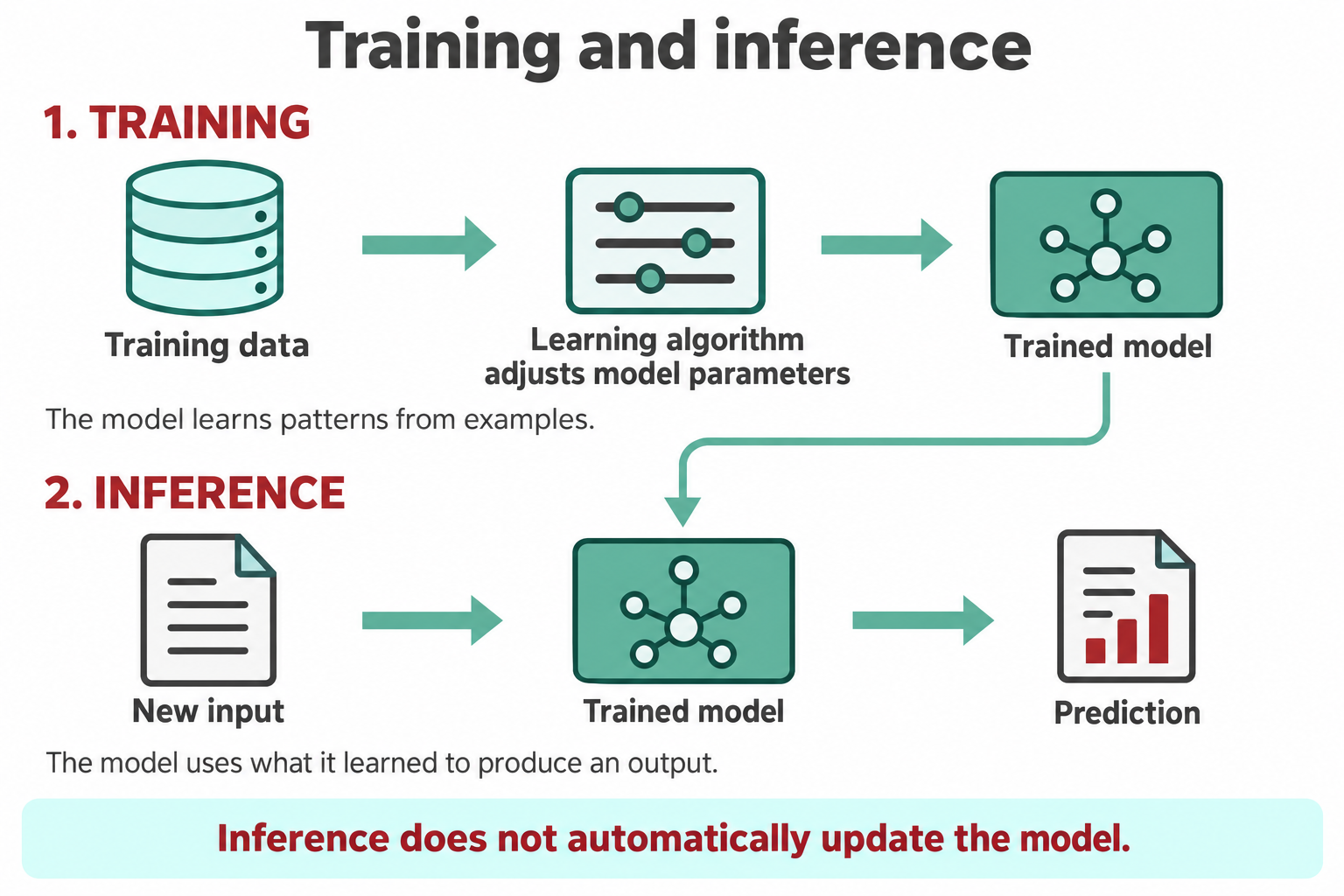
Illustrative example: a decision tree learns to classify emails as spam or not spam using labelled examples and features such as word frequencies. The decision rules are learned from the training data.
Humans still select data, choose methods, and evaluate results. Learning from data does not mean that the system needs no programming or human guidance. More about machine learning (IBM).
3. Deep learning (DL)
Deep learning is a subset of ML that uses artificial neural networks with multiple layers to learn representations of data.
Each layer transforms its input. During training, the network adjusts its parameters so that these transformations help produce the required output. In image recognition, layers can learn more complex visual features.
Illustrative example: a deep neural network learns to recognise handwritten digits from labelled images. During training, it learns useful features from pixel data.
Deep learning often reduces manual feature engineering, but people still prepare data and design, train, and test models. Large deep-learning models can require substantial data and computing resources; these requirements vary by task and model. More about deep learning (IBM).
Compare the three concepts
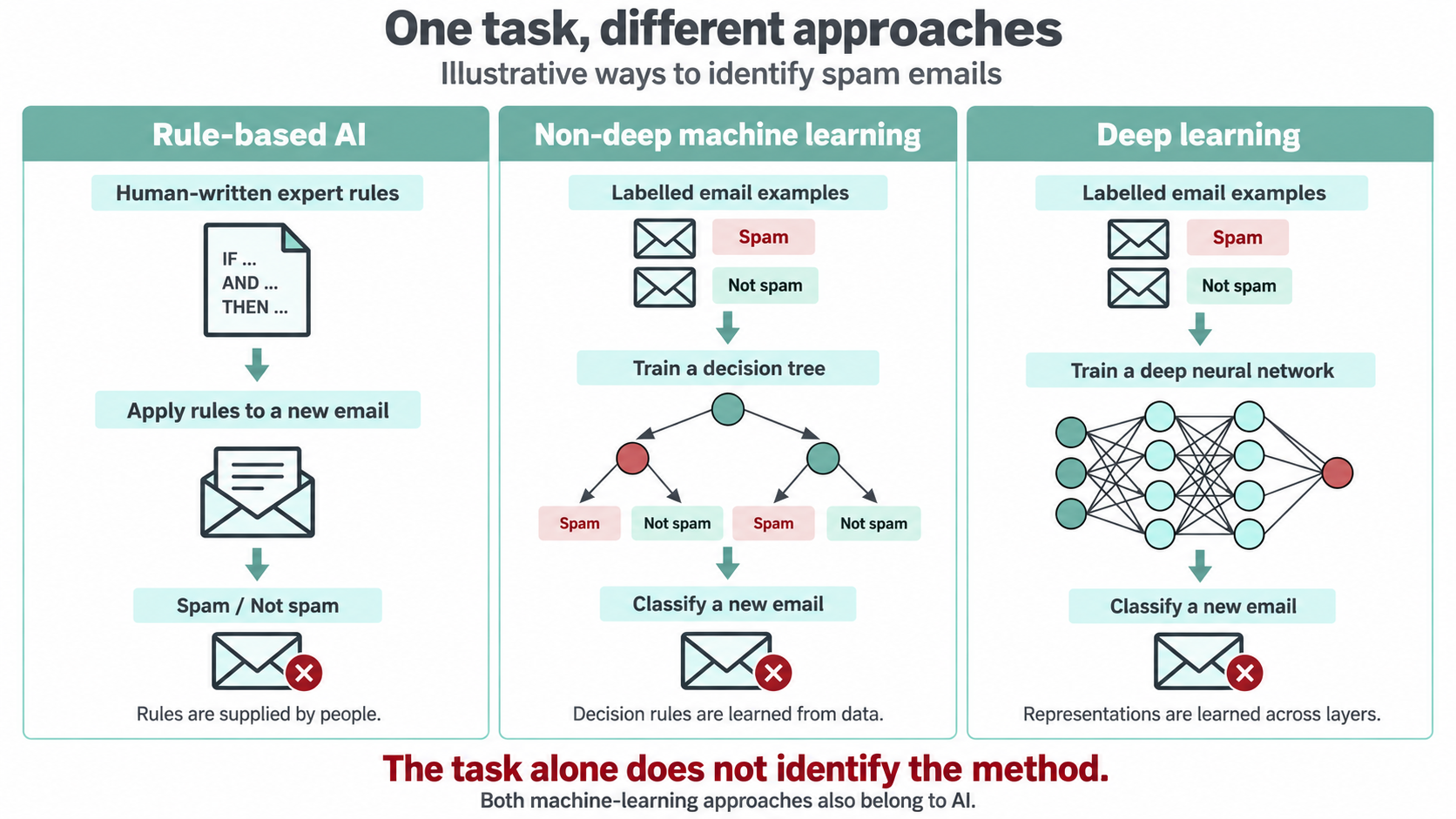
AI is the broad category; ML and DL are nested subsets.
| Aspect |
AI |
ML |
DL |
| Scope |
Broad field |
Subset of AI |
Subset of ML |
| Defining characteristic |
Performs tasks associated with intelligence |
Learns patterns from data |
Learns using a deep neural network |
| Must learn from data? |
No |
Yes |
Yes |
| Must use a deep neural network? |
No |
No |
Yes |
| Illustrative method |
Rule-based expert reasoning |
A decision tree trained on examples |
A multilayer neural network trained on images |
When comparing non-deep ML with DL, describe data and computing requirements as typical tendencies, not fixed rules. A large dataset alone does not prove that a system uses deep learning.
How to identify the most specific category
- Look for evidence of deep neural networks. If present, identify DL; ML and AI also apply.
- Otherwise, look for learning from training data. This supports ML. It does not establish DL unless the architecture is described.
- Look for explicitly programmed expert reasoning. This can support AI without ML when no learning takes place.
- If only the application is named, ask for more information. “Recognises faces” describes a task, not the method used.
Answer frame: “The most specific category supported by the description is ___ because ___. It also belongs to ___.”
Activity 1 — Identify and justify
For each learning process organization scenario, identify the most specific category supported by the description and provide supporting evidence. Do not assume an architecture that is not specified.
- An expert system uses specialist-written rules to diagnose computer faults. It does not learn from cases.
- A decision tree learns email classifications from labelled training examples.
- A neural network with many hidden layers learns to recognise handwritten digits.
- A recommendation model is trained on previous user choices. Its architecture is not described.
- A product description says only: “This application recognises faces.” Can you conclude that it uses DL?
Assessment: 10 marks. Award 1 mark for each correct classification or recognition of insufficient evidence, and 1 mark for the supporting explanation.
Show answers and marking guidance
- AI without ML: expert rules are written by people; no learning takes place.
- ML, not DL: the decision tree learns from labelled data and is not a deep neural network. AI also applies.
- DL: learning uses a neural network with many hidden layers. ML and AI also apply.
- ML: training on previous choices establishes learning from data. There is insufficient information to determine whether it is DL. AI also applies.
- No: the description gives the purpose but no evidence of a deep neural network.
Accept equivalent explanations. Award the classification mark only when the answer is as specific as the description supports.
Activity 2 — Correct the misconceptions
Correct each statement and explain your change.
- All AI systems learn from data.
- ML and DL are unrelated technologies.
- A large dataset automatically makes a model deep learning.
- A trained model always learns from every new input.
Show suggested corrections
- AI includes approaches based on predefined expert knowledge as well as learning.
- DL is a subset of ML.
- The use of a deep neural network defines DL; dataset size alone does not.
- Inference uses a trained model; further learning requires an updating or training process.
Self-check
- Can I explain why every DL system is also ML and AI?
- Can I give an example of AI that does not use ML?
- Can I identify the evidence needed to distinguish ML from DL?
- Can I recognise when a description provides insufficient information?
Key takeaway: AI describes the broad field, ML identifies learning from data, and DL identifies learning with deep neural networks.
Exercises
Ex. 1 Matching Pairs.
Ex. 2 Assign each system to the most specific group.
Ex. 3 Complete the text using the correct terms.
Ex. 4
Ex. 5 Read each description and enter the correct term.
Ex. 6