|
Learning objectives:
11.3.1.2 describe the purpose of OS, utilities, program libraries, translators
System software
Exercise Zero. https://www.101computing.net/drag-and-drop/software.html
Definition
Software consists of sequences of instructions, called programs, that can be understood and executed by hardware.
System software Classification
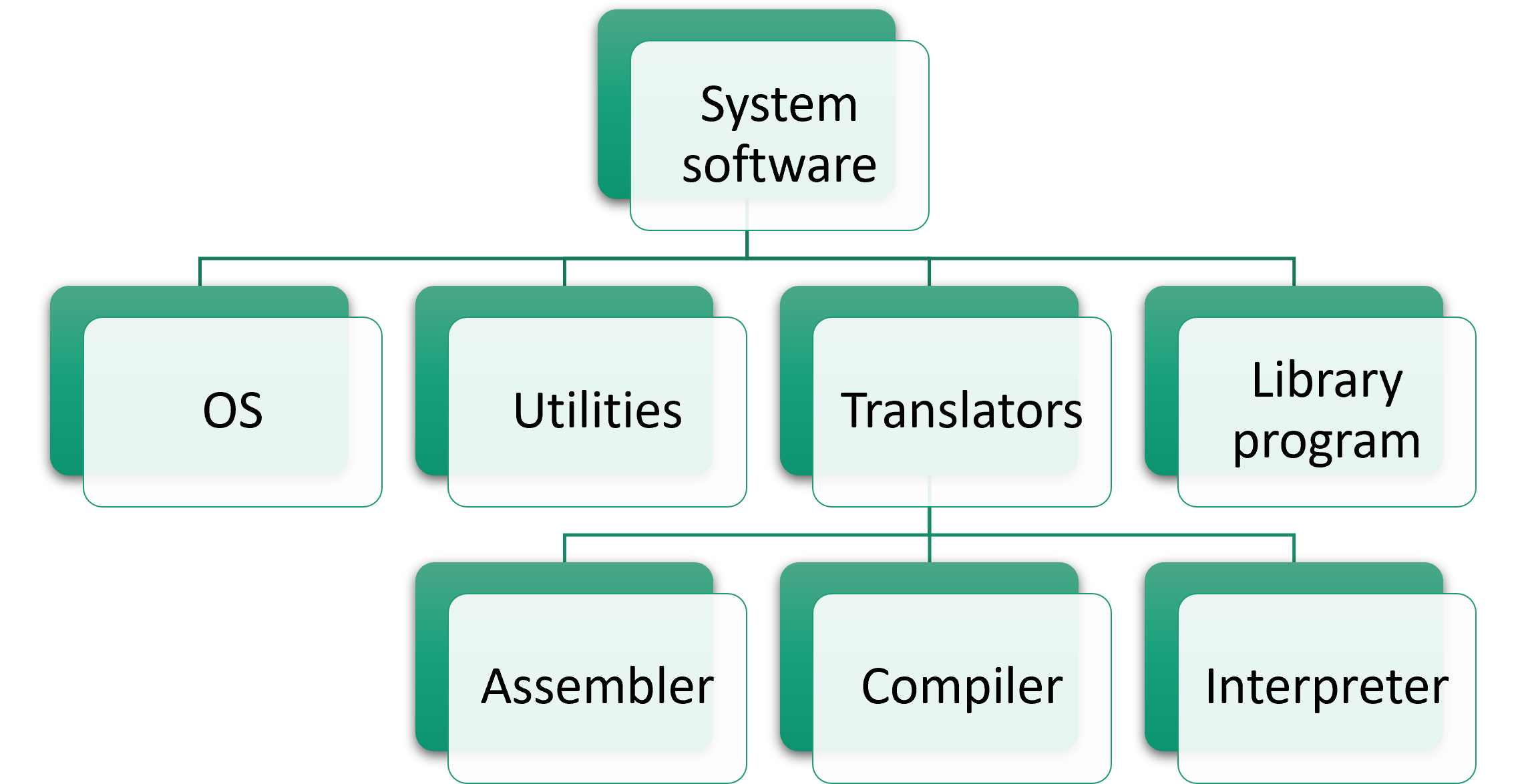
System software is software that controls and manages the basic operations of a computer.
Sub-Categories of System software
| System software |
Definition |
Key features |
| Operating Systems (OS) |
Manage computer hardware, software resources, files, and provide an interface for users and applications.
|
• Process management
• Memory management
• File management
• User interface
• Device management
|
| Utilities |
Perform maintenance, security, optimization, and management tasks.
|
• System maintenance
• Virus protection
• File compression
• Backup and recovery
• Disk management
|
| Translators |
Convert programs written in programming languages into machine code that the computer can execute.
|
• Compiler
• Interpreter
• Assembler
• Error detection
• Code translation
|
| Library Programs |
Provide pre-written functions and routines that other programs can use to perform common tasks. |
• Reusable code
• Pre-written functions
• Saves development time
• Supports common operations
• Can be shared by programs |
Questions:
- Name the four main sub-categories of system software.
- Explain why an operating system is considered system software.
- A computer cannot communicate with a newly installed device. Which type of system software could solve this problem? Explain your choice.
- Explain the difference between a translator and a library program.
- A student says, “Utility software is more important than the operating system.” Do you agree? Justify your answer.
Exercises:
Ex.1 Match the terms with the definitions.
Ex.2 Classify the system software.
Ex.3 Complete the Text.
Exam questions:
|